- Apolitical Newsletter
- Posts
- (A)Political - November 1st
(A)Political - November 1st

Atlas News
November 01, 2025
Good morning everyone,
Even during a shutdown, politics have not taken a backseat in Washington! Let’s get into it!
Federal judges have now ordered the Trump admin to restore SNAP benefits during the ongoing government shutdown. DOGE department sets sight on renewing US drone demand. Iran states their ire after U.S. nuclear tests.
Federal Court Orders SNAP To Be Restored During Gov Shutdown
DOGE Drone Overhaul
Iran Angered In U.S. Testing Of Nuclear Warheads
Federal Court Orders SNAP To Be Restored During Gov Shutdown
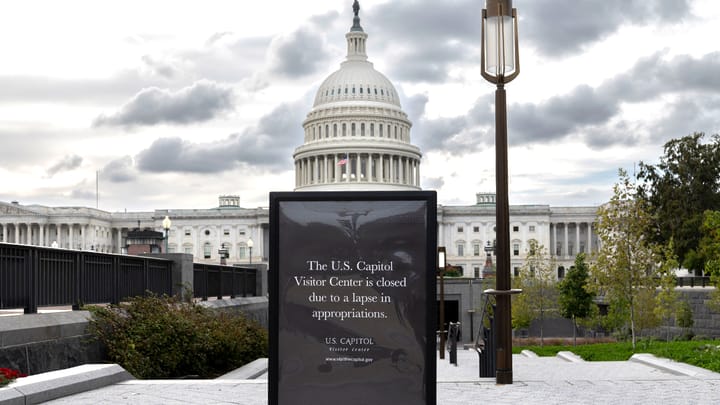
A sign reading "The U.S. Capitol Visiting Center is closed due to a lapse in appropriations" is displayed at the entrance of the Capitol Visiting Center. (Probal Rashid - LightRocket via Getty Images)
By: Atlas
Two federal judges ordered the Trump administration to continue disbursing Supplemental Nutrition Assistance Program (SNAP) benefits during the ongoing government shutdown, directing the U.S. Department of Agriculture (USDA) to use contingency funds to prevent a lapse. The orders, issued minutes apart by U.S. District Judges Indira Talwani in Massachusetts and John J. McConnell in Rhode Island on Friday, Oct. 31, require the government to fund November benefits at least in part from reserves that Congress previously set aside for program operations.
Judge Talwani’s written order characterized the planned suspension as unlawful and instructed the government to report by Monday on whether it would pay full benefits using contingency and other available funds, or partial benefits from the contingency reserve. From the bench, Judge McConnell similarly directed USDA to tap the reserve “as soon as possible” and asked for a status update by Monday.
USDA had warned that November benefits would be frozen starting Nov. 1 due to insufficient appropriations during the shutdown. The rulings block that plan and obligate the department to utilize available reserves while the broader funding dispute continues.
Funding sources, scope, and legal posture
At issue is a SNAP contingency fund of roughly $5–$5.3 billion, which the courts said must be used to sustain benefits during the lapse. The judges also referenced additional “available funds,” noting that monthly benefits cost about $8.5–$9 billion nationwide and that the reserve alone would not cover a full month. Both orders left open whether payments would be partial or full, pending the government’s update.
In their reasoning, the courts rejected USDA’s position that the shutdown barred use of the contingency reserve, pointing to statutory language that permits those funds to be used “as necessary to carry out program operations.” The Massachusetts order framed SNAP as a mandatory program that, if funds exist, must be administered, and directed the government to clarify how it would proceed.
USDA has argued that the Antideficiency Act limits its authority during a funding lapse and that the reserve cannot be tapped without an active appropriation stream. The rulings countered that interpretation and instructed the agency to use the contingency reserve now, with further detail due on whether other sources can be lawfully accessed to maintain benefits in November.
Operational impact and timelines
Even with the orders in place, the timing of benefit disbursement remains a near-term challenge. Many states require several days to load Electronic Benefit Transfer (EBT) cards, meaning households that typically receive funds at the start of the month could see delays as agencies implement the court directions. Judges in both cases set Monday deadlines for updates, a timeline that acknowledges administrative lead times for state distribution systems.
Program scale is central to the logistics. SNAP serves about 42 million people and typically requires $8.5–$9 billion each month. Plaintiffs and state officials told the courts that an unprecedented lapse would strain food banks and local support networks that cannot substitute for federally issued benefits. The contingency reserve is designed for continuity of operations; the courts’ orders convert that provision into an immediate directive while the shutdown persists.
In Rhode Island, Judge McConnell also ordered that existing work-requirement waivers remain in force during the shutdown. That direction prevents separate administrative changes from reducing eligibility or access while funding questions are resolved, and it adds to the operational checklist states must follow as they prepare November issuances.
Positions of the parties and political context
The lawsuits—one led by a coalition of Democratic attorneys general and the District of Columbia, and another by cities, nonprofits, and a union—argued that funds remained available to fulfill SNAP obligations despite the shutdown. They pointed to the contingency reserve and to other accounts that, they said, could be lawfully used to avert a lapse. The courts agreed that the reserve must be tapped and required the government to address whether additional funding paths exist to meet November needs.
The administration has maintained that USDA lacked authority to pay benefits without a new spending bill and that the reserve could not be used absent an active appropriation. Following the Rhode Island ruling, the president posted that lawyers would seek court guidance on how to legally fund SNAP and signaled the administration would follow the law once clarified, while cautioning that state distribution could still take time.
Lawmakers responded along party lines. Some called the orders necessary to preserve food assistance during the shutdown; others questioned whether courts could direct the executive branch’s use of funds during a lapse. Regardless of political statements, the immediate effect of the rulings is to require USDA to use the reserve and to report back promptly on how it will execute that directive for November issuances.
Next steps and indicators to watch
The first indicator is the government’s Monday filings in both cases. Those updates are expected to specify whether benefits will be fully funded using the contingency reserve and other accounts, or partially funded from the reserve alone, and to outline the timeline for state-level disbursements. The courts could issue further instructions based on those reports.
A second indicator is USDA’s coordination with states on EBT processing. Notices to state SNAP directors, load schedules, and any temporary adjustments—such as staggered issuance or proration if necessary—will show how quickly the orders translate into funds on cards. Any change to work-requirement waivers would also need to reflect the Rhode Island order maintaining current exemptions.
Finally, watch for appellate activity. The Justice Department may seek review in the First Circuit, particularly on questions about the Antideficiency Act and executive discretion during a shutdown. Unless a higher court stays the district courts’ orders, USDA remains obligated to use the contingency reserve immediately and to report its plan to sustain November benefits under the parameters the judges set.
In practical terms, the rulings establish that SNAP cannot be suspended at the outset of November solely due to the shutdown, given the existence of contingency funds. The program’s scale and the mechanics of state distribution mean some delays are likely, but the courts’ orders define a funding path that must be used while Congress and the administration remain at an impasse over broader appropriations.

Subscribe to (A)Political to read the rest.
Delivered every Saturday, our team provides comprehensive reporting on the key political events shaping the nation, offering perspectives from both sides of the aisle. Join over 20,000 readers and stay informed with an unfiltered take on the significant developments in the corridors of power.
Already a paying subscriber? Sign In.
A subscription gets you:
- • A date with AOC
Reply