- Apolitical Newsletter
- Posts
- (A)Political - March 28th
(A)Political - March 28th

Atlas News
March 28, 2026
Good morning everyone,
It’s been a wild week in D.C! Let’s go!
The Senate has passed a bill that funds most parts of DHS, but the bill hangs in the fate of the House. White House officials are now debating an additional deployment of 10,000 combat troops in support of Operation Fury. A Florida Congressional Representative has been found guilty of 25 separate ethics violations.
Senate Votes Unanimously In Favor Of DHS Funding Bill, Reaches Impasse At The House Of Representatives
White House Mulls Additional Deployment 10,000 Troops To Middle East
Florida Congressional Rep Found Guilty Of 25 Ethics Violations
Senate Votes Unanimously In Favor Of DHS Funding Bill, Reaches Impasse At The House Of Representatives
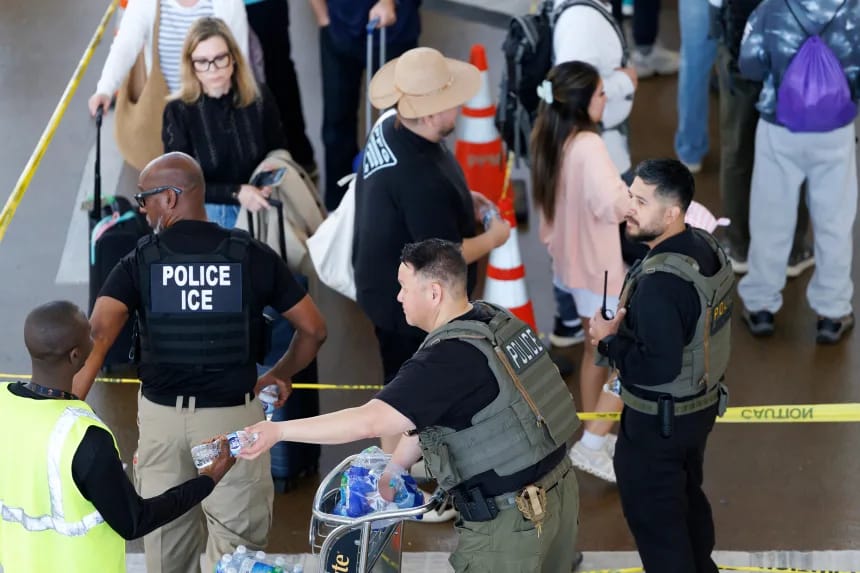
ICE agents hand out water bottles in TSA lines at George Bush Intercontinental Airport in Houston, Texas, on Thursday. (Mark Felix - Bloomberg - Getty Images)
By: Atlas
The Senate voted unanimously early Friday morning to fund most of the Department of Homeland Security, ending a 42-day standoff that left TSA agents working without pay and turned airport security lines into hours-long ordeals across the country. The deal covers the Federal Emergency Management Agency, the Coast Guard, the Transportation Security Administration, and U.S. Customs — but not Immigration and Customs Enforcement or Border Patrol.
The bill died on arrival in the House. Speaker Mike Johnson told reporters his chamber would not take up the Senate measure and would instead pursue a 60-day stopgap that fully funds every DHS component, including the immigration enforcement agencies the Senate left out.
"It is unconscionable to me that the Democrats would force some sort of negotiation at three o'clock in the morning and try to foist this upon the American people and then get on their jets and go home for their holiday — and pretend and think that we're going to go along with that," Johnson said. He added that he did not believe every Senate Republican had even read the bill before it passed by voice vote.
The result: 42 days into the shutdown, with TSA workers missing their second consecutive paycheck, neither chamber has produced legislation the other will accept. Congress left for a two-week Easter and Passover recess with no resolution in sight.
What the Senate Bill Does and Doesn't Fund
The package funds the bulk of DHS operations for the remainder of the fiscal year. TSA, FEMA, the Coast Guard, the Secret Service, and the Cybersecurity and Infrastructure Security Agency all receive their appropriations. U.S. Customs operations are funded. Border Patrol is not.
ICE — the agency at the center of the political fight — gets nothing in the bill. Senate Majority Leader John Thune acknowledged that outcome was less than what Republicans had sought. "We've been trying for weeks to fund the whole thing," he told reporters. "In the end, this is what they were willing to agree to. But again, it's different that it has zero reforms in it. They got no reforms on DHS."
The bill includes $20 million for body cameras for immigration officers but does not require agents to wear them. It does not bar ICE agents from wearing face masks during operations, a change Democrats had pushed for. It does not require judicial warrants before agents enter private homes — another Democratic demand. In short, the bill contains no new restrictions on immigration enforcement.
Senate Minority Leader Chuck Schumer said the deal could have been reached weeks ago and declared that Democrats had "held the line" to prevent a "blank check" for what he called "lawless" immigration operations. He pledged the party would keep fighting to ensure enforcement agencies "do not get more funding without serious reform."
The Fight Behind the Shutdown
The funding impasse traces back to early February, when Congress failed to pass a DHS spending bill before the deadline. Democrats held up the legislation after federal immigration officers fatally shot two U.S. citizens — Renee Good and Alex Pretti — during enforcement operations in Minnesota in January. The shootings prompted Democrats to demand structural changes to how ICE and Border Patrol conduct operations.
Their asks included mandatory body cameras, a ban on face masks during raids, prohibitions on enforcement near schools and churches, and a requirement that judges — not just agency supervisors — sign warrants before agents search homes or private spaces. New Homeland Security Secretary Markwayne Mullin, confirmed by the Senate earlier this week, had indicated openness to considering the judicial warrant requirement.
Republicans resisted attaching enforcement restrictions to a spending bill, arguing the conditions would hamstring the agencies responsible for carrying out Trump's immigration agenda. The GOP had already secured $75 billion in additional ICE funding through last year's reconciliation bill, meaning immigration enforcement officers continued to be paid throughout the shutdown even as TSA agents and other DHS employees went without.
Seven previous attempts to pass a DHS funding bill failed before the eighth succeeded early Friday.
Airport Chaos and the TSA Crisis
The most visible consequence of the shutdown has been the breakdown at America's airports. Nearly 500 TSA transportation security officers have quit since the shutdown began. On a single day last week, more than 3,120 officers called out sick — an 11 percent no-show rate nationwide. Individual airports reported callout rates exceeding 40 percent.
Passengers at some of the country's busiest hubs faced wait times of four hours or more. George Bush Intercontinental Airport in Houston recorded some of the worst delays, where even former Attorney General Bill Barr was photographed waiting among thousands of stranded travelers. A top TSA official testified to Congress that the agency was experiencing the longest wait times in its 25-year history and warned that smaller airports could be forced to close if the impasse continued.
Some TSA agents resorted to selling their blood plasma and sleeping in their cars to get by. Melissa Gates, a traveler at Houston's airport, told reporters she had waited more than two and a half hours without reaching the security checkpoint and missed her flight to Baton Rouge. "I should have just driven, right?" she said. "Five hours would have been hilarious next to this."
Trump deployed ICE agents to airports earlier this week to help backfill missing TSA staff. On Thursday, he announced he would sign an executive order directing Homeland Security Secretary Mullin to pay TSA agents immediately using emergency authority and funds from last year's tax bill. "Because the Democrats have recklessly created a true National Crisis, I am using my authorities under the Law to protect our Great Country," Trump wrote on Truth Social.
House Republicans Push for Full Funding
Johnson rejected the Senate bill outright and said the House would move "as soon as possible" on a 60-day continuing resolution that funds the entirety of DHS, including ICE and Border Patrol. He said Trump had expressed support for the approach.
Rep. Chip Roy of Texas called the Senate deal "absolutely offensive" to his constituents in Border Patrol who have been working without pay. Rep. Lauren Boebert of Colorado told Senate schedulers on social media to "book a return flight for your boss." Conservative members of the House Freedom Caucus have also rejected the Senate measure, insisting on full immigration enforcement funding.
But the 60-day stopgap faces its own problems. Senate Democrats have already signaled it would not pass the upper chamber. Schumer's office said the proposal would simply delay the same fight by two months without addressing the underlying disputes over enforcement policy.
The standoff leaves Congress in a familiar stalemate. The Senate passed a bill the House will not take up. The House is proposing a bill the Senate will not pass. TSA workers may receive emergency pay through executive action, but the broader question of DHS funding — and the immigration enforcement restrictions Democrats are seeking — remains unresolved heading into a two-week recess.
Everett Kelley, president of the American Federation of Government Employees, said the union was grateful TSA workers would be paid but urged Congress to stay in session. He called for a deal "that funds DHS, pays all DHS workers, and keeps these vital agencies running."
That deal, for now, does not exist.

Subscribe to (A)Political to read the rest.
Delivered every Saturday, our team provides comprehensive reporting on the key political events shaping the nation, offering perspectives from both sides of the aisle. Join over 20,000 readers and stay informed with an unfiltered take on the significant developments in the corridors of power.
Already a paying subscriber? Sign In.
A subscription gets you:
- • A date with AOC
Reply