- Apolitical Newsletter
- Posts
- (A)Political - April 4th
(A)Political - April 4th

Atlas News
April 04, 2026
Good morning everyone,
It’s been a wild week! Let’s get into it!
Multiple U.S. aircraft have been shot over Iranian airspace. Trump has fired Pam Bondi from her position as Attorney General. Vice President Vance has taken on the role of ‘Fraud Czar’ and is leading the prosecution of embezzlement (especially blue states in the crosshairs).
Multiple U.S. Planes Shot Down Over Iran
Trump Fires Bondi From AG Position
VP Vance To Focus Fraud Investigations On ‘Blue States’
Multiple U.S. Planes Shot Down Over Iran
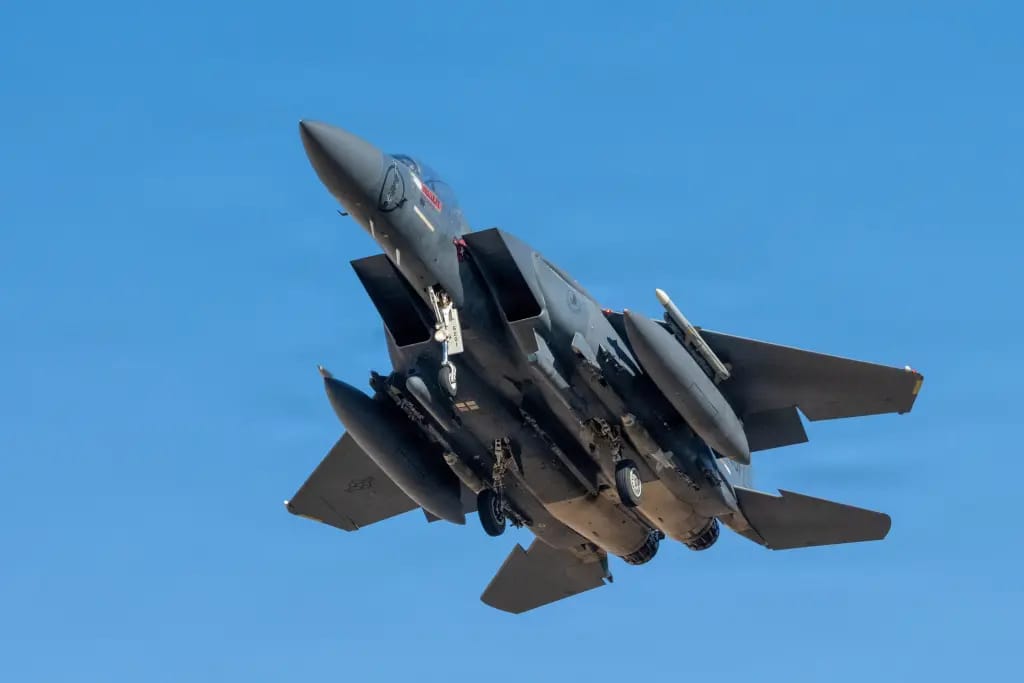
F-15E Strike Eagle aircraft (Centcom Public Affairs)
By: Atlas
The air war over Iran entered a different phase on April 3 when U.S. aircraft were shot down during combat operations, producing the first confirmed American fixed-wing losses to enemy fire in the conflict. Until then, officials had publicly described Iranian air defenses as heavily degraded and had pointed to the scale of U.S. and Israeli strike operations as evidence that the battlefield was increasingly permissive. The events of that day showed otherwise.
The central incident involved an F-15E Strike Eagle, a two-seat aircraft used for deep strike missions. U.S. officials said the jet was brought down over Iran, with its crew ejecting. One crew member was recovered, while a search continued for the second. At the same time, a separate U.S. aircraft also went down in the broader theater. Officials identified that second aircraft as an A-10 attack plane, whose pilot ejected and was later rescued.
Those two aircraft losses were not the only damage reported that day. Two U.S. Black Hawk helicopters involved in the recovery effort were also hit by Iranian fire, though both made it back. Taken together, the incidents marked the most serious setback for American air operations since the war began in late February.
The military significance was immediate. American aircraft had been flying sustained combat sorties over Iran for weeks. The loss of multiple aircraft in a single day suggested that whatever damage had been done to Iran’s defenses, its forces still retained the ability to engage U.S. aircraft in meaningful ways.
What happened over Iran
The F-15E incident became the focus of the day because of where it happened and because one of the two aircrew remained unaccounted for. Officials said the aircraft was shot down over Iranian territory, making it the first known U.S. fighter lost inside Iran since the start of the war. President Donald Trump was briefed, and administration officials confirmed that a recovery mission was underway. Publicly, however, the Pentagon was initially limited in what it would say.
Iranian state-linked media moved quickly to publish images they said showed the wreckage. Early Iranian reports described the aircraft as an F-35, but that account did not hold up under subsequent scrutiny. Analysts examining the images said the visible tail-fin sections and ejection-seat components were more consistent with an F-15E Strike Eagle. That matched the description later given by U.S. officials.
The Strike Eagle carries two crew members, unlike the single-seat A-10 involved in the separate incident. Officials said one member of the F-15E crew was rescued, but the status of the second remained unclear for hours and then into the next day. Reporting indicated that congressional aides were told the Defense Department did not know the person’s whereabouts, which in operational terms meant the possibility of evasion, injury, or capture could not be ruled out.
The second aircraft loss was reported in a separate incident involving an A-10. Officials said the pilot ejected and was recovered. Accounts differed on whether the aircraft crashed directly in Kuwaiti airspace or after sustaining damage elsewhere in the theater, but the core fact was consistent across reporting: the aircraft was hit, the pilot got out, and the pilot was rescued.
For the U.S. military, the F-15E mattered most not because the aircraft itself was uniquely irreplaceable, but because the missing crew member turned a shoot-down into a personnel recovery crisis inside hostile territory. That shifted the operational burden almost immediately from strike execution to locating and extracting an aircrew member before Iranian forces could do the same.
The rescue effort and the danger around it
Combat search-and-rescue missions are among the most difficult operations air forces carry out. They require aircraft to slow down, loiter, communicate, and sometimes descend inside airspace where the threat has already proven real. That is what happened after the F-15E went down. Rescue aircraft were dispatched, including helicopters, and the effort itself came under fire.
Two Black Hawk helicopters involved in the operation were struck by Iranian fire, according to U.S. officials. Both aircraft returned safely, but injuries were reported among the personnel on board. That detail mattered because it showed the recovery mission was not a routine pickup at the edge of the battlespace. It was taking place in an environment where Iranian forces were still able to contest the airspace and engage American aircraft after the initial shoot-down.
Iranian media and officials compounded the pressure by publicizing the incident and encouraging civilians to help locate the downed Americans. Some reports described television anchors and officials calling on Iranians to find the surviving crew, while state-linked outlets circulated images and location claims online. That added a political layer to what was already a military race. The longer the missing crew member remained unaccounted for, the more likely the episode would become a broader diplomatic and strategic problem.
The search also undercut the administration’s broader public narrative. Only days earlier, the president had described Iran’s anti-aircraft and radar systems as effectively destroyed. Yet here were U.S. aircraft being hit, rescue helicopters taking fire, and American personnel possibly on the ground inside Iran. The battlefield described in official rhetoric did not fully match the one American forces were navigating in real time.
What the losses changed
These incidents did not reverse the broader military balance, but they did clarify the kind of war the United States was actually fighting. For years, American aircraft have mostly operated against adversaries without advanced integrated air defenses. Iran, even after weeks of bombardment, remained a state actor with enough surviving capability to impose costs. That was the main military lesson of April 3.
Retired U.S. air officers noted that the rarity of American shoot-downs in recent decades says as much about the opponents the United States has faced as it does about the invulnerability of U.S. airpower. In wars against insurgents or militias, aircraft losses to enemy air defense are uncommon because the enemy lacks the systems. In a war against a state still able to field missiles, guns, radar, and dispersed defensive positions, losses are a normal risk even for a far stronger air force.
That is why the downing of the F-15E and the loss of the A-10 carried weight beyond the day’s tactical events. They showed that Iran still had enough air-defense capacity to reach American aircraft, and that those hits could force the United States into even riskier operations to recover aircrews. One shoot-down became several damaged aircraft, multiple rescue flights, and a second crisis layered on top of the first.
There was also a strategic consequence. Once a U.S. aircraft is downed and an American service member is missing inside enemy territory, the conflict takes on a different political character. Public debate shifts from whether the campaign is succeeding in aggregate to whether the administration can explain how a supposedly suppressed adversary was still capable of bringing down aircraft and threatening rescue teams. That question became unavoidable after April 3.
In the narrower military sense, the day established three facts. An F-15E was shot down over Iran. A separate U.S. aircraft also went down, and its pilot was rescued. Two rescue helicopters were hit while trying to recover a missing aircrew member. Those are concrete battlefield developments, and they indicate that the air war remained contested despite repeated claims that Iran no longer had the means to fight effectively in the skies.

Subscribe to (A)Political to read the rest.
Delivered every Saturday, our team provides comprehensive reporting on the key political events shaping the nation, offering perspectives from both sides of the aisle. Join over 20,000 readers and stay informed with an unfiltered take on the significant developments in the corridors of power.
Already a paying subscriber? Sign In.
A subscription gets you:
- • A date with AOC
Reply